Mark Ling & Commission Cycle: Who Created the Affiliate Marketing Program?
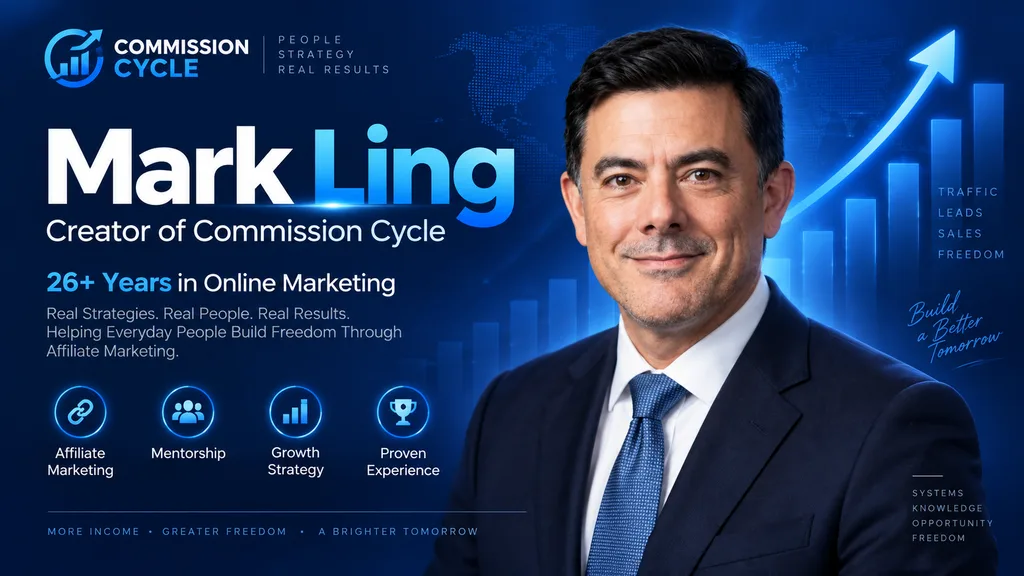
Mark Ling is the creator of Commission Cycle and a longtime affiliate marketer whose online marketing career dates back to 1999. His latest program brings together social-media traffic, affiliate funnels, automation, AI-assisted tools, and the reinvestment principles he says have remained useful throughout more than two decades of changing traffic platforms.
Commission Cycle may be a new program, but Mark Ling is not new to affiliate marketing.
Long before Instagram reels, AI content tools, automated DMs, or even modern social media existed, Ling was building online campaigns around search traffic and affiliate offers. That history is relevant because Commission Cycle is largely based on one idea: traffic sources change, but the economics behind a profitable marketing business remain remarkably similar.
Who Is Mark Ling?
Mark Ling is a New Zealand-based entrepreneur, affiliate marketer, and online marketing educator.
According to Affilorama, Ling entered affiliate marketing in 1999 while studying at the University of Canterbury in Christchurch, New Zealand. At the time, search engines such as Yahoo and Excite played a much larger role in online traffic than they do today.
That gives him more than 26 years of online marketing experience as of 2026.
His career has crossed several generations of internet marketing:
- early search engines;
- Google and SEO;
- paid traffic;
- email marketing;
- Facebook;
- YouTube;
- social-media marketing;
- AI-assisted content and automation.
That timeline helps explain the philosophy behind Commission Cycle.
Rather than betting everything on one traffic platform, Ling focuses on the business process underneath the traffic.
Mark Ling and Affilorama
Mark Ling is probably best known for founding Affilorama, an affiliate-marketing education platform launched in 2006.
Affilorama says Ling had already spent years working as an affiliate, product owner, and affiliate-program manager before creating the training site. The platform was developed to teach others how to build affiliate businesses through areas such as niche research, websites, search traffic, email marketing, paid advertising, and product promotion.
Affilorama’s public company information says the platform grew to more than one million members and identifies Ling as a co-founder of Affilorama, SaleHoo, and their parent company, Doubledot Media Limited.
That history matters.
Here’s what most people don’t know: affiliate marketing in 1999 looked almost nothing like affiliate marketing today.
Someone who remained active through that period had to adapt repeatedly.
A ranking strategy that worked on an early search engine eventually became irrelevant. Facebook changed. Google changed. YouTube changed. Now AI and short-form social content are changing the process again.
The platform changes are obvious.
The underlying business principles are less dramatic.
How Mark Ling’s Experience Connects to Commission Cycle
Commission Cycle reflects that distinction.
The current program emphasizes traffic from platforms such as Instagram and YouTube, supported by short-form content, one-word replies, automated direct messages, affiliate offers, and AI-assisted marketing tools.
Those are modern tactics.
But the central Commission Cycle concept is more traditional.
Mark Ling describes business profit using four variables:
Leads × Conversions × Average Revenue per Sale × Average Number of Sales per Customer
The strategy then involves reinvesting part of the commissions generated by the business into whichever lever offers the most practical opportunity for improvement.
In simple terms, imagine a campaign has plenty of leads but converts poorly.
Buying more traffic may not be the smartest move.
Improving conversion could create more revenue from the visitors already arriving.
If conversions are healthy but each customer produces only one small commission, increasing customer value may offer a better opportunity.
That is the thinking behind the “cycle.”
Earn → Reinvest → Improve → Earn More → Repeat
The traffic source can change without completely changing that underlying framework.
Mark Ling’s Affiliate Marketing Approach
Looking through Ling’s earlier Affilorama material shows several themes that still appear in his current work.
One is building an audience rather than relying entirely on individual transactions.
In an older article explaining what he would do if forced to start again, Ling discussed creating useful content, building an email list, attracting traffic, and eventually developing additional products and promotional opportunities around that audience.
That same basic logic appears in Commission Cycle, although the entry point is now more social-media focused.
The modern version can look like:
Social Content → Engagement → Automated Conversation → Lead → Affiliate Offer → Follow-Up
Technology makes the process faster.
It doesn’t eliminate the marketing fundamentals.
That distinction is worth remembering whenever AI is involved.
AI can produce a script quickly.
It cannot guarantee that people will care about the script.
AI can create a funnel.
It cannot guarantee the offer is right for the audience.
The marketer still makes those decisions.
Mark Ling’s Role Inside Commission Cycle
Commission Cycle is presented as more than a standalone self-study course.
Mark Ling’s role extends into the mentorship and implementation side of the program.
Current program materials describe elements including:
- an 8-week mentorship;
- social traffic training;
- affiliate offer strategies;
- AI-assisted funnel tools;
- automated DM systems;
- faceless video creation;
- live Commissions Club sessions;
- a 60 Day Demo campaign;
- longer-term support.
One potentially useful element is the campaign demonstration.
Marketing usually looks cleaner when explained afterward than it does while being built.
Watching decisions, adjustments, and testing happen during an actual campaign can provide a different kind of education from simply watching finished training modules.
What About Mark Ling’s Student Results?
Current Commission Cycle promotional materials reference substantial historical sales generated by people Mark Ling has taught.
Those figures should be interpreted carefully.
They are presented as aggregate historical student sales, not expected earnings for a new Commission Cycle member.
Sales volume also isn’t the same thing as profit.
Individual results in affiliate marketing can vary widely depending on the offer, traffic source, experience, budget, conversion rates, consistency, and execution.
Creator experience is worth considering.
It should never be treated as an income guarantee.
Is Mark Ling’s Background Relevant Before Joining?
Yes, particularly because Commission Cycle is positioned as premium training rather than a low-cost introductory course.
When evaluating a program like this, useful questions include:
Has the creator worked in the business model being taught?
Has that experience lasted through more than one temporary traffic trend?
Is there a public history that can be independently checked?
In Mark Ling’s case, his connection to affiliate marketing since 1999 and the launch of Affilorama in 2006 are publicly documented.
That establishes experience.
It does not establish what any individual purchaser will earn.
Those are two different things.
If you’re evaluating the complete program rather than only the person behind it, read the full Commission Cycle review for a closer look at the training, pricing, strengths, limitations, and who the program may suit.
Learn More About Mark Ling’s Commission Cycle
Mark Ling brings a long affiliate-marketing background to Commission Cycle, but the program itself is built around current tools and traffic behavior.
The combination includes social content, automated conversations, affiliate funnels, AI-assisted production, customer-value strategies, and reinvestment.
The technology is new.
The basic objective isn’t:
attract the right people, convert attention into sales, improve the economics, and keep building from what works.